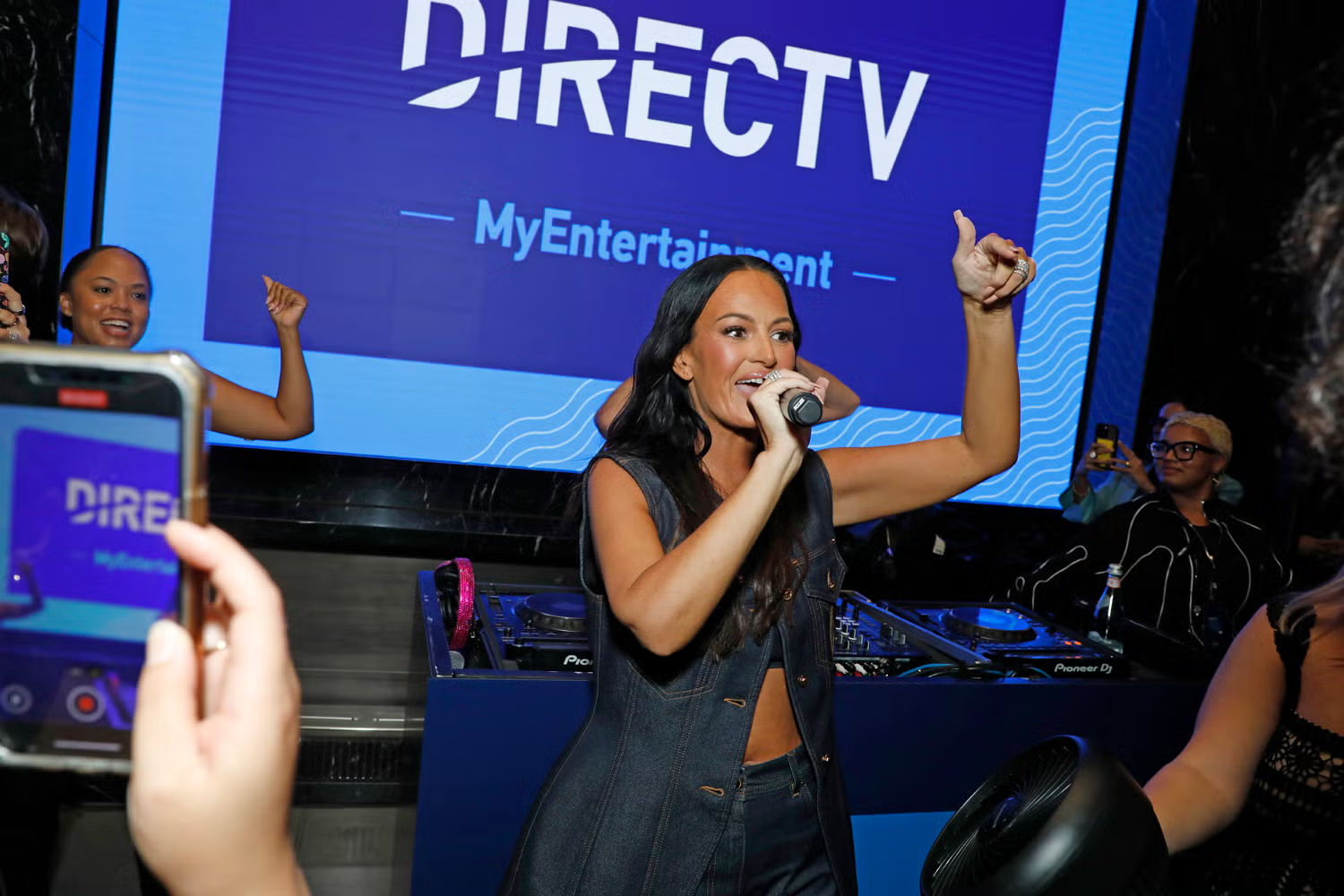

In brand experience design, “cinematic” is less a look than a method. It is controlled perception—deliberate framing, intentional sequencing, and a managed emotional cadence across touchpoints. The effect does not require extravagant fabrication. It requires coherence, continuity, and disciplined choices that remain legible both in a room and on a screen.
An activation or event is the container. A brand moment is the consequence: the segment of people who remember, record, and recount it. Designing for the moment changes priorities. It shifts effort toward narrative clarity, compressible meaning, and an experience that produces documentation as a natural byproduct rather than a desperate afterthought.
Cinematic thinking also assumes two audiences. The on-site audience navigates through movement, proximity, and social cues. The on-camera audience encounters edited fragments—thumbnails, captions, shaky footage, compromised audio. What feels intuitive in person can become incoherent online, while what reads cleanly on a phone can feel sterile in real life. The work is to reconcile both without splitting the concept into incompatible versions.
The first tactic is to write a single-sentence premise. It should state who the experience is for, what they are meant to do or discover, and why it matters in brand terms. This premise functions as a constraint system. Under production pressure, it prevents aesthetic drift and keeps decisions consistent.
Next, define a “promise scene”—the one beat that must occur for the brand promise to become visible. This is where utility, craft, transformation, or expertise is demonstrated rather than described. If the build must be simplified, the promise scene remains intact because it carries attribution and meaning.
Tactic two is to design a three-act journey for real people. Act one orients: clear entry, clear rules, minimal friction. Act two escalates: exploration, interaction, and a rising specificity that sustains attention. Act three resolves: comprehension and a decisive exit state, whether that is a purchase, a sign-up, or a story worth repeating. Within the journey, micro-conflicts maintain momentum—choice, constraint, reveal, or small challenge—without devolving into gimmickry.
Tactic three is to treat humans as narrative infrastructure. Roles such as host, guide, craftsperson, or expert carry tone and exposition more efficiently than signage. They also correct misunderstandings in real time. Extend this to the audience by offering a role beyond “consumer.” When attendees can inhabit an identity—investigator, collaborator, tastemaker, learner—participation becomes clearer, hesitation drops, and the experience becomes easier to read for observers.
Tactic four translates visual grammar into space. Plan sightlines. Create depth through layering: foreground cues, midground interactions, background world-building. Use controlled reveals—turns, partitions, curtains, portals—so the concept cannot be consumed instantly. Support this with a strict palette and material system tied to brand codes. Constrained color reduces noise and stabilizes recognition; materials telegraph quality and “genre” before copy is processed.
Tactic five uses lighting as narrative punctuation. Threshold lighting can announce entry into a new act. Spotlighting can isolate product truth. Softer light can create intimacy for consultation or storytelling, while contrast can add emphasis if legibility remains intact. Lighting must also be capture-aware: mixed color temperatures distort footage, and low light forces phones into noisy exposure. The goal is a mood that remains readable on common devices.
Tactic six treats sound as invisible scenography. Music and ambient layers set the pace, modulate crowd energy, and differentiate zones without additional construction. Voice matters, too: staff cadence and phrasing act as tonal signatures. Pair the soundscape with an intentional quiet zone—a decompression pocket where people can absorb meaning, ask questions, or decide. This is often where conversion happens because cognitive load is lower and conversation is possible.
Tactic seven is to engineer “beats” every 30–90 seconds. A beat is a perceptual turn: new information, a new interaction, or a new vantage point that signals progress. Beats prevent drift, bottlenecks, and dead time. Make transitions explicit with thresholds—portals, hallway compression, scent shifts, or changes in sound texture—so people understand where they are in the story and what comes next.
Tactic eight is to design a signature moment for retelling. Retellability depends on semantic clarity: a moment that can be summarized in one sentence without losing its point. That sentence should align with what the brand wants repeated. Spectacle should also function as proof. The “wow” must be tethered to a claim—performance, craft, durability, comfort, taste, expertise—so the moment operates as evidence, not decoration.
Tactic nine codifies consistency with a “show bible.” This production document standardizes tone, palette, language rules, wardrobe direction, music parameters, typography, and explicit do/don’t constraints. It makes quality repeatable across staff shifts and future builds. Staff training should be treated as direction: opening lines, guidance language, escalation protocols, and a shared narrative vocabulary that keeps the story from fracturing during peak traffic.
Tactic ten plans content capture as a parallel production. A capture plan should respect attendees while guaranteeing usable media: shot lists, designated hero angles, controlled backdrops, and predictable schedules. Build modular outputs by design—short-form loops that crop cleanly, stills with negative space for copy, testimonial prompts embedded while the experience is fresh, and behind-the-scenes footage that remains evergreen.
Measurement should match the medium. Dwell time indicates whether the environment holds attention. Completion rate through the acts shows whether the journey is navigable. Opt-in or conversion rates in the quiet zone reflect decision readiness. Content outputs per hour indicate whether the moment was engineered for documentation. Post-mortems should be specific: where confusion surfaced, which beat delivered the clearest proof, what people recorded most, and what they repeated verbatim.
A cinematic brand moment is not guaranteed by scale. It is earned through constraints, sequencing, sensory control, and proof. When the story is legible, the pacing intentional, and the claim demonstrated, spectacle stops being a mere ornament. It becomes attribution with consequences.