
Valentine’s Day marketing has long operated as a public audit of intimacy. What has shifted is the operating system. Many of the most visible activations in 2025 and into early 2026 leaned away from a single, couple-centric romance script and toward small, intelligible rituals—things people can do quickly, document easily, and carry away as proof of participation. The prevailing bias is toward action: build, write, scan, attend, exchange. The artifact is the message.
A notable throughline is the broadening of Valentine’s framing beyond couples. Some campaigns explicitly positioned the season around friendship, self-expression, and nontraditional relationship structures, treating “love” as a plural category rather than a single storyline. That change is not merely rhetorical. It widens the addressable audience and reshapes the experience brief. The successful executions tend to offer social belonging without requiring a romantic premise—something a person can do with friends, coworkers, or alone, without feeling like an interloper in a holiday built for pairs.
Another recurring motif is the elevation of offline connection as a feature, not a garnish. Experiential work has increasingly treated in-person interaction as the product’s most persuasive demonstration: co-presence, however brief, becomes the value. In this logic, the rose is less an icon than a pretext. It creates a reason to show up, complete a shared task, and leave with a tangible remainder.
The mechanics are often straightforward, but carefully engineered. LEGO’s Botanicals “Le Florist” Flower Truck Tour translated a product line into a roaming set: floral displays, selfie moments, and interactive workshops where participants built custom blooms to take away. The tour began in New York City at Madison Square Park from Jan. 31 to Feb. 2, 2025, then continued through other markets, supported by short online workshops led by florist Jeff Leatham. The concept’s portability is part of its strategy. A touring activation behaves like distributed media—replicable city by city rather than trapped in a single pop-up.
Other brands optimized for frictionless entry by overlaying spectacle onto existing consumer behavior. Raising Cane’s and Coca-Cola staged a drive-thru “Tunnel of Love” installation in Grand Prairie, Texas, running from Jan. 31 through Feb. 16, 2025. Reported details included more than 2,000 hours of construction, an animated light show, a heart-shaped entry archway, 20,000 lights, and 3,000 roses, plus timed giveaways and on-site moments such as an adoption event on Feb. 14. The drive-thru format matters because it reduces the cost of participation. People do not have to learn a new routine; the activation simply amplifies one they already have.
Some executions treated Valentine’s as a premium hospitality theater. Princess Cruises staged a shoreside pop-up of its Love by Britto dining experience in New York City at Currents at Pier 59 on Feb. 13–14, 2025, offering a five-course menu with cocktails and Britto artwork. Coverage cited a $214 per-person price point—numerically keyed to 2/14—with reservations handled through Tock and proceeds going to Save the Children. Here, romance is operational: ticketing, time windows, and a defined beginning and end. The event functions as an experiential preview for an onboard concept.
Humor remained central, but the better campaigns treated it as a mechanism rather than a tone. Charmin’s #PreventTheDump campaign tied bathroom logistics to romantic viability, then extended the premise into scheduled, opt-in dating environments via Thursday events in New York City (Feb. 6) and Chicago (Feb. 14, 2025). Charmin’s release cited survey findings, including that 76% of Americans consider premium toilet paper a “green flag.” The joke is intentionally absurd, yet disciplined: it gives singles a place to meet, with the brand as the improbable catalyst.
Legacy products also evolved through utility-forward interaction. Sweethearts shifted from novelty phrases toward scannable hearts that route consumers to different resources depending on what they scan—ranging from moving services to marriage-license support—playing with contemporary relationship ambiguity and escalation. The move effectively grafts digital routing onto a physical confection, turning a familiar object into a decision tool rather than a static message.
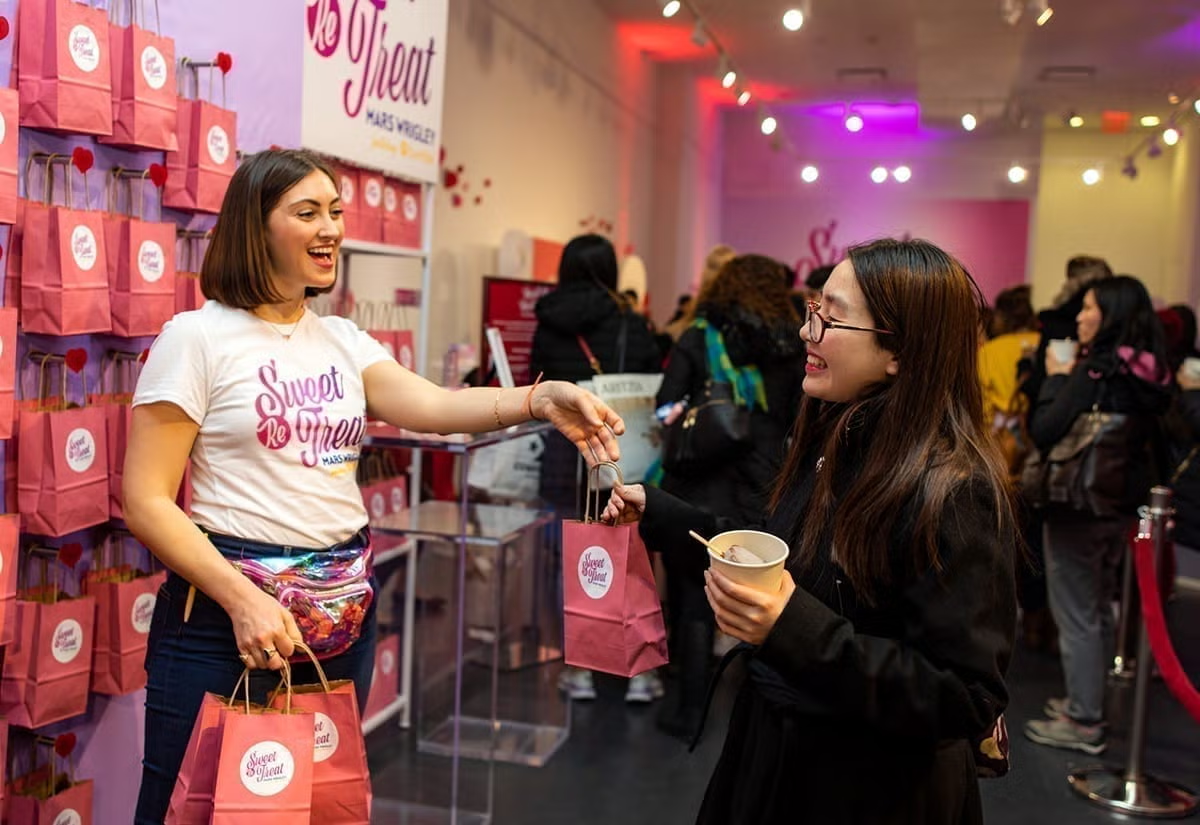
Several activations relied on “love notes” as content infrastructure—low-pressure prompts that manufacture shareable output without forcing performance. Examples include Mars’ Sweet ReTREAT message wall and Snuggle’s #BearYourHeart, which invited New Yorkers to write sentiments on oversized cards, photograph them, and see them incorporated into a public, real-time digital mosaic. The brands behave less like authors of affection and more like curators of it.
At the same time, “anti-Valentine’s” has become a credible audience strategy rather than a contrarian aside. Event coverage has pointed to post-breakup audiences as underserved, including a Burger King anti-Valentine’s exchange concept tied to a film release. Other trade roundups emphasized heartbreak as culturally current: Who Gives A Crap’s “World dump day” positioned a bespoke break-up letter-writing service as more personal and eco-conscious than an AI-generated message, while Panadol Extra’s campaign transformed harsh breakup texts into music-format content, explicitly acknowledging emotional pain as real even if the product cannot literally resolve it. Cadbury Creme Egg’s “Gooey Love Songs” and a compatibility quiz similarly converted consumption behavior into identity play, while BMB’s “Love, sweet love” chocolate box used candid flavor descriptors as an editorial device on relationships.
The risk is that intimacy-coded marketing can backfire when the recipient context is uncontrolled. A frequently cited caution is Deliveroo’s promotion that distributed discount codes disguised as handwritten cards addressed to “My Valentine,” which prompted backlash and a subsequent apology. The lesson is procedural: when campaigns borrow personal signifiers—handwriting, private address language—the line between playful and coercive can thin quickly.
Some brands used the Valentine’s window to stage harder narratives by contrast rather than celebration. Campaign coverage described Allianz Ireland and Women’s Aid’s “The Dead Flower Shop,” a one-day activation that appeared to be a normal flower shop from the outside but displayed dead flowers within, with bouquets representing women killed by a partner. It is a stark use of Valentine’s aesthetics to confront violence that can be concealed behind romantic veneers.
Product-led seasonal moves also operated as “activations” by design. Reports noted Hershey introduced Kit Kat Bears for Valentine’s Day 2026—teddy bear-shaped Kit Kats with hearts, sold in 25-count packs with built-in “to/from” tags geared for exchanges. Harper’s Bazaar reported Pandora partnered with Katseye on a Valentine’s campaign built around a mini charms collection with “Dream Charms,” with price points cited in the $20–$35 range and a friendship-forward framing. In both cases, the object carries the participation cues; the gift is pre-formatted.
Across these examples, what “hits the mark” is rarely vague sentiment. It is operational clarity. The strongest activations specify a single human job-to-be-done—connection, closure, gifting, belonging—then encode it into an action people can complete and share. Timing also increasingly reflects a season, not a single day, with experiences starting before Feb. 14 and extending after; even outside Valentine’s-specific framing, premium retail treated February as a visitation window, such as an immersive Louis Vuitton Soho pop-up reported as running through mid-February 2026. Measurement naturally follows the mechanics—attendance, reservations, scans, content outputs—while lifecycle marketers often pair seasonal attention with segmentation and personalized follow-ups, as reflected in Klaviyo’s Valentine’s marketing guidance.
Valentine’s Day will always reward sentiment. What has become more evident is the preference for sentiment that can be enacted—briefly, publicly, and without pretense—while still accommodating the modern emotional spectrum: hearts, humor, and, when necessary, heartache.